Settlement & Partition Deeds Go Paperless in TN (Nov 2026)
Many families in Tamil Nadu register property within the family: parents giving a house to a son or daughter, brothers dividing ancestral land, or a sister releasing her share. The way these deeds are registered changed on 2 November 2026. The Registration Department has moved four family deeds to paperless registration on its STAR 3.0 system. Below is what changed, which deed fits your case, and how to make sure the patta follows the deed.
At a glance
| Point | Detail |
|---|---|
| Effective from | 2 November 2026 |
| Ordered by | Government Order issued by Registration Department Secretary Kumaraguruparan |
| Deeds covered | Settlement, partition, release, cancellation of settlement |
| Platform | STAR 3.0, through tnreginet.gov.in |
| Sub-Registrar Office visit | Still needed, once |
| Stamp duty / registration fee | The reports on the order mention no change |
Why this came now
Since 17 August 2026, sale deeds for houses and plots can be registered without going to the Sub-Registrar Office (SRO). Family deeds were announced as the next step and were first due in mid-October. Once the software for these four deeds was ready, the department fixed 2 November as the start date.
This matters because family transfers, especially of ancestral land, are where patta records most often stay wrong for years.
Which family deed are you registering?
Settlement deed: giving property to a family member in your lifetime
Common between parents and children or between spouses. Patta impact: if the whole survey number goes to the person receiving it (the settlee), it is a plain patta transfer. If only part goes, a subdivision is needed.
Partition deed: dividing joint property among co-owners or heirs
Each sharer gets a defined portion. Patta impact: every sharer needs their own patta, so this almost always needs a subdivision of the survey number.
Release deed: giving up your share to another co-owner
Common when one sibling keeps the family house. Patta impact: the name of the person giving up the share (the releasor) should come off the joint patta.
Cancellation of settlement
This is the most sensitive of the four. Registering a cancellation does not by itself undo a settlement in law. Talk to a property lawyer before you draft one.
Paperless does not mean presence-less
People mix these two up, so here is the difference:
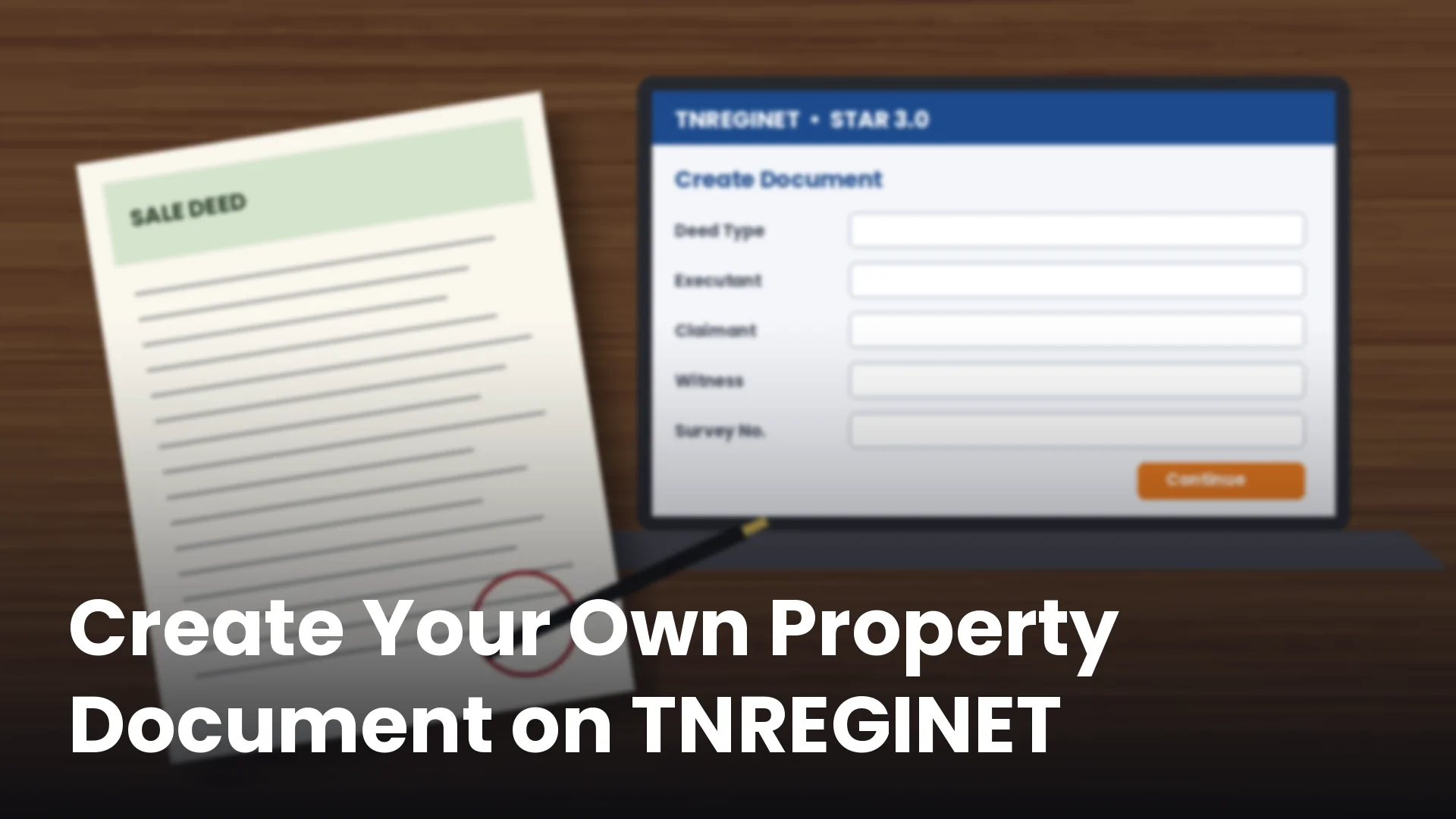
- What is paperless: you don’t bring a typed paper deed to be scanned. You create the deed online, upload the supporting documents, e-Sign with an Aadhaar OTP and book a token.
- What still needs you there: every party and the witnesses go to the SRO once, at the booked time, for identity checks and Aadhaar biometric authentication (fingerprint or iris).
- What you get back: the Sub-Registrar e-signs the registered deed and returns it to your TNREGINET login.
The online route in five steps
On 12 November 2026 the Registration Department explained its STAR 3.0 paperless process and named settlement and partition among the examples. The process runs like this:
- Log in on tnreginet.gov.in and choose the deed type.
- Enter the details of every party, the witnesses and the property. You get a TP number.
- Check the draft PDF under My Documents, then pay the stamp duty and registration fee online.
- Choose paperless registration, enter the TP number, e-Sign with the Aadhaar OTP and book your date and time.
- Attend the SRO with all the parties and witnesses.
Family-deed checklist before you log in
- Parent document: the deed through which the family got the property, with its registration number
- Current patta and chitta: the name on it should match the parent document
- Encumbrance Certificate for the survey number
- For a partition: each sharer’s portion with survey or subdivision number, extent and boundaries. Agree on the sketch within the family before drafting.
- If the property belonged to a parent who has died: death certificate and legal heir certificate
- Aadhaar linked to a working mobile number for every party
After registration: make the patta follow the deed
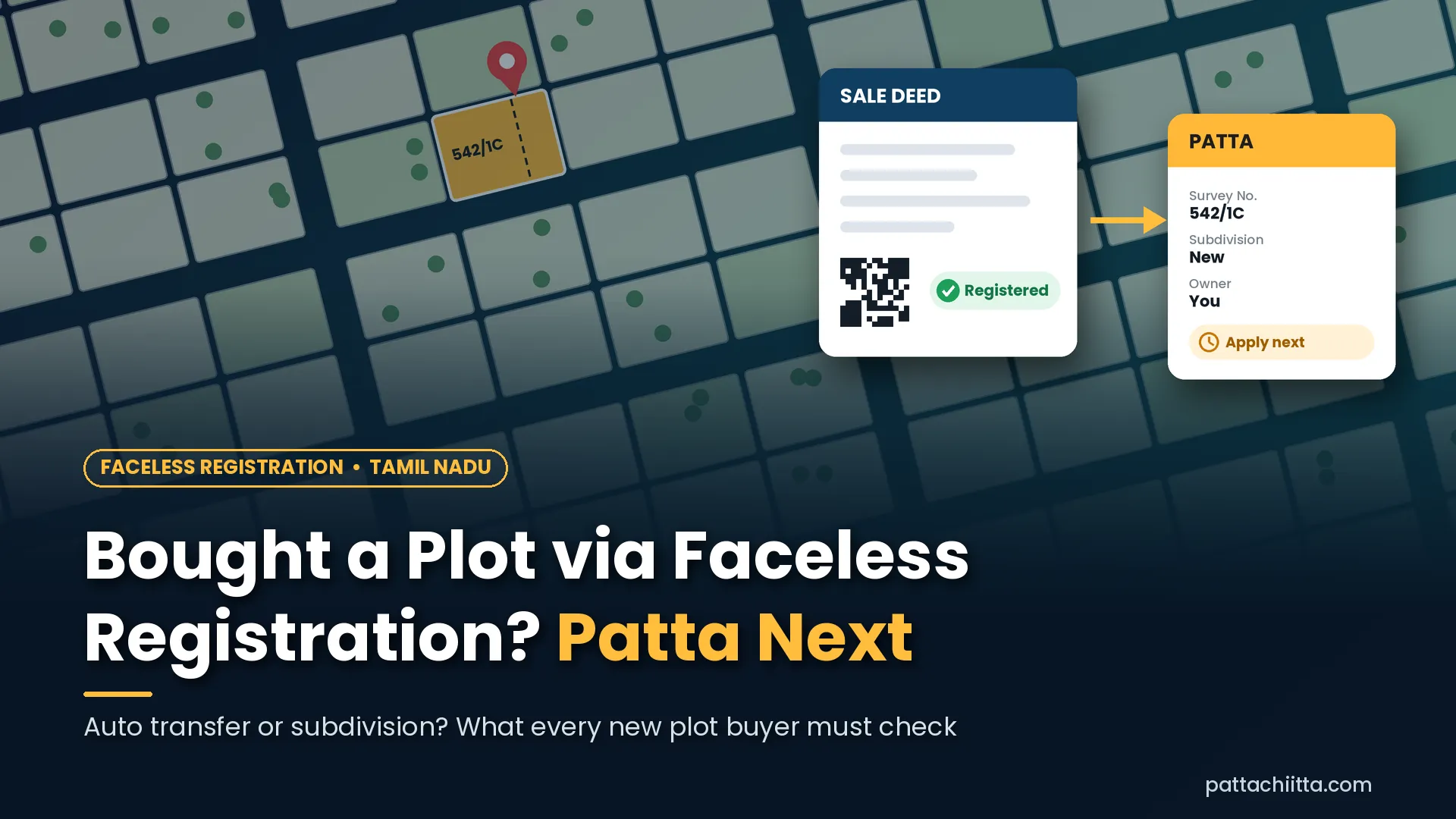
No split (whole survey number moves): this is a transfer without subdivision. It is the kind of case the state’s automatic patta transfer is meant to handle after registration. If the name doesn’t change, read why the patta doesn’t change automatically after registration and apply for the transfer yourself.
Split (most partitions, part settlements): apply for a subdivision patta transfer at an e-Sevai centre or online at tamilnilam.tn.gov.in/citizen. State rules require subdivision petitions to be decided within 30 days and non-subdivision petitions within 15 days.
Each sharer should check the result on eservices.tn.gov.in. Look at the survey number, the subdivision and the extent, not just the name.
What hasn’t changed, plus one more update
- Charges: the reports on the order don’t mention any change in stamp duty or registration fee. Check the amount on the payment screen.
- Saturday closure: under a separate Government Order, Sub-Registrar Offices have been closed on Saturdays since 1 November 2026. Book a weekday token.
For more step-by-step help with land records, see our Tamil Nadu patta chitta guides.